Jasper Trevane
New Life as a Max Level ArchmageJasper Trevane is an Orichalcum-ranked ranger-adventurer from the Central Kingdom, recognized for poison-coated arrows, a threat-scanning vigilance, and a refusal to perform the polished deference expected in aristocratic company. His importance emerges during the convoy disaster, where his instinctive competence and reluctant command stabilize a scattered group of adventurers and identify the only practical method of recovering the power cores.
Identity and Introduction
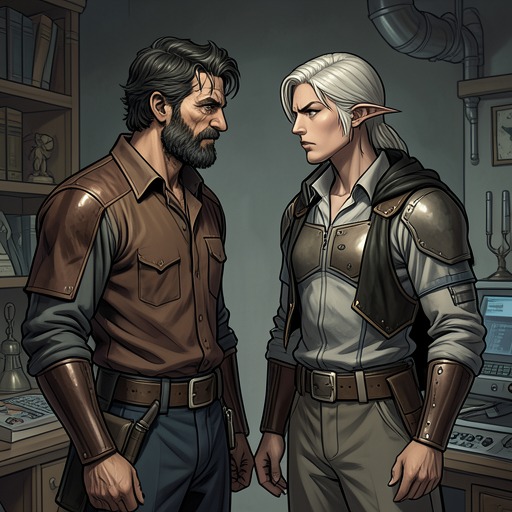
Jasper first appears as a newcomer whose physical presentation immediately marks him as a field specialist rather than a courtly adventurer. He carries a longbow and quiver, wears dark browns and greens, and has a thin, stubbled face, a prominent nose, and blue eyes. Before engaging with anyone, he scans the room for threats; his attention lingers on Vivisari Vexaria with narrowed interest before he turns away. The green badge on his chest identifies him as Orichalcum rank, placing him among the kingdom’s most capable adventurers.
His entrance also establishes his social independence. Lord Barnaby Caldimore gives him an extravagant welcome as one of the kingdom’s finest, addressing him as Jasper Trevane, but Jasper does not answer with aristocratic ceremony. He walks directly to the food and drink, waves away a servant’s assistance, tears the cork from a wine bottle with his fingers, and drains eight deep gulps before acknowledging Barnaby. The gesture is comic, but it is also diagnostic: Jasper is not interested in presenting obedience, refinement, or gratitude merely because an influential nobleman is watching.
Saffra identifies him as a poison specialist who coats his arrows, though she cannot remember his guild or party and considers him less famous than some other Orichalcum adventurers. Her assessment does not diminish his practical stature. Even while calling him an imperfect role model because of his rapid drinking, she repeatedly watches him with admiration, and his rugged appearance and sarcastic manner leave an impression on Vivisari Vexaria as well.
Function During the Convoy Crisis
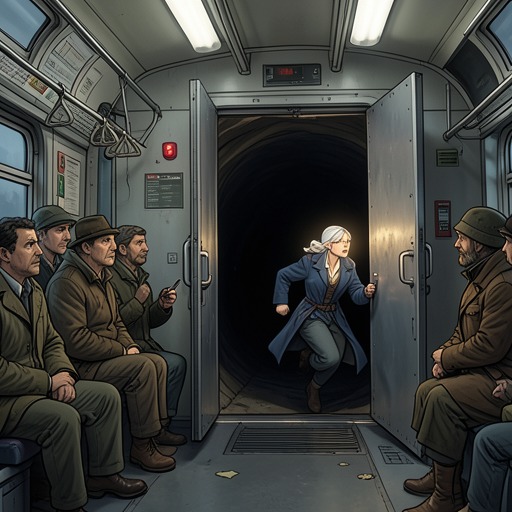
Jasper’s defining qualities become unmistakable after the convoy derails. While Saffra checks herself for injuries and realizes that Vivisari Vexaria’s protective spells, rather than the Lounge’s enchantments alone, have kept the survivors safe, Jasper is the first person to act. He reaches the exit, jumps for the release lever, and pulls it open. His action is small in physical scale but large in narrative effect: amid wreckage, frightened civilians, and the absence of the strongest available protector, he supplies the first clear movement toward escape and organization.
The survivors gather near the less-damaged section of the convoy, while dozens of adventurers above Bronze rank stand outside and debate what to do. Jasper admits that he hates being the leader and insists that leadership is not his role. Nevertheless, he immediately performs it. He calls for everyone’s attention in an authoritative voice, divides the adventurers into Silver, Gold, and Mithril groups, and assigns each rank to a separate stretch of grass so that the available strength can be assessed. The contradiction between his complaint and his conduct defines him more accurately than either statement alone: he does not seek command as an honor, but accepts its necessity when disorder threatens lives.
His authority does not depend on a title or formal appointment. The heated discussions stop when he speaks, and the assembled adventurers turn toward him. Saffra also finds herself drawn into their attention, shrinking from the sudden scrutiny even as Jasper creates a structure in which the group can act. His leadership is therefore both operational and social. He transforms a crowd into categories, categories into resources, and panic into a problem that can at least be examined.
Strategy and Tactical Intelligence
The crisis appears unsolvable because the Ghul-Feather is a Titled-rank monster guarding the convoy’s power cores. The adventurers cannot see how anyone can approach the creature, withstand its attacks, seize the cores, and retreat. Jasper’s solution depends on recognizing the monster’s behavior rather than attempting to overpower it. He explains that Ghul-Feathers are cowardly and rely mainly on ranged attacks. The recovery therefore requires someone effectively invulnerable to the creature’s attacks: that person can walk directly into the danger zone, take the cores, and leave, at which point the Ghul-Feather will abandon the fight if it cannot kill the intruder from a distance.
The plan is deliberately simple, but its simplicity is not naivety. Jasper isolates the encounter’s governing condition and turns the monster’s supposed advantage into a limitation. The old woman listening to him points out the absurd difficulty of finding someone invulnerable to a Titled-rank monster, yet Saffra understands what Jasper is implying and feels both fear and hope. The strategy quietly redirects attention toward the missing Vivisari Vexaria, whose power might satisfy the requirement even though she has been sent away on what suddenly appears to be a pointless retrieval task.
Jasper’s intelligence is thus grounded in observation, classification, and behavioral prediction. He does not claim that the Ghul-Feather can be defeated by ordinary force, nor does he promise that the mission is safe. Instead, he defines the narrow condition under which the cores can be recovered. That is the same practical mindset visible in his first entrance: scan for threats, ignore ceremony, identify what matters, and act before discussion becomes paralysis.
Relationships and Narrative Contrast
Jasper’s first interactions with Barnaby Caldimore establish a contrast between noble hospitality and adventurer informality. Barnaby treats him as a celebrated figure, while Jasper answers the social performance with wine, silence, and delayed acknowledgment. The exchange suggests that Jasper’s reputation is substantial even when his name is not universally familiar, but it also shows that he does not allow aristocratic approval to dictate his behavior.
His presence affects Saffra differently. She regards him as competent at the moment competence matters most, and her relief at seeing him take action is immediate. At the same time, she remains critical of his drinking and does not turn admiration into unqualified idealization. Her response presents Jasper as a flawed but credible field leader: someone whose habits may be questionable, yet whose judgment under pressure is exactly what the crisis requires.
Vivisari Vexaria’s reaction is more detached but still revealing. She finds his refusal of stiff politeness amusing, notices his sarcastic attitude, and acknowledges his rugged handsomeness without developing a romantic attachment. Jasper therefore enters the story as a figure observed from several angles: Barnaby sees a distinguished adventurer to be honored, Saffra sees a possible role model in competence, and Vivisari Vexaria sees an entertainingly uncooperative professional.
Characterization and Narrative Role
The evidence presents Jasper as a practical counterpoint to the legendary Party of Heroes. Prismarche’s Temple displays images of saints and heroes, including Vivisari Vexaria and her party, while the priest explains that the Party of Heroes defeated the seventh and final Cataclysm a century earlier, at the cost of all its members except the Sorceress. The city’s Peace Day celebrations continue to revere that victory, even though later generations know the Cataclysms chiefly through inherited stories and public memorials.
Against that monumental history, Jasper’s heroism is immediate, unceremonious, and procedural. He does not arrive as a statue or savior in stained glass. He arrives scanning for threats, drinking wine, pulling an exit lever, sorting adventurers by rank, and proposing a behavioral solution to a monster problem. The contrast does not erase the Party of Heroes’ significance; it clarifies the difference between remembered salvation and ongoing survival. A world that celebrates its ancient champions still depends on living specialists who can organize frightened people after the train leaves the tracks.
Jasper also helps preserve the story’s uncertainty about power. In the convoy crisis, the group needs someone nearly invulnerable to a Titled-rank monster, and Vivisari Vexaria’s absence makes that need painfully visible. Much later, after Vivisari Vexaria effortlessly tears a Greater Voidbeast apart, the spectacle is so extreme that witnesses are more likely to believe a god has descended than that the returning Sorceress alone could possess such power. Jasper’s grounded tactical competence provides the opposite image: he works within recognizable limits, making the impossible manageable through knowledge of the enemy and disciplined coordination. Together, these contrasting forms of power broaden the story’s idea of heroism, from mythic force to practiced judgment.